Deploying a strategy
Auto-Managed QQQ: Own the Nasdaq-100, With an Exit Plan
Own QQQ. With rules that step out and back for you.

Written by
Amaltash Research
Amaltash Advisors LLC
Reviewed by



Arpit AgarwalCharvi AgarwalThe Amaltash Team
QQQ is one of the most traded symbols on the market. It was among the five largest ETFs by assets under management as of Oct 2026. It consists of some of the biggest names in tech and has risen substantially over the five years ending Oct 5, 2026, with large declines along the way, including a 35.6% drop in 2022. That is why so many people own it. It has grown strongly over the long run, and it spreads your money across many companies instead of betting on one.
But spreading your money out does not remove the bad stretches. QQQ fell hard in the 2020 COVID crash and again through 2022.
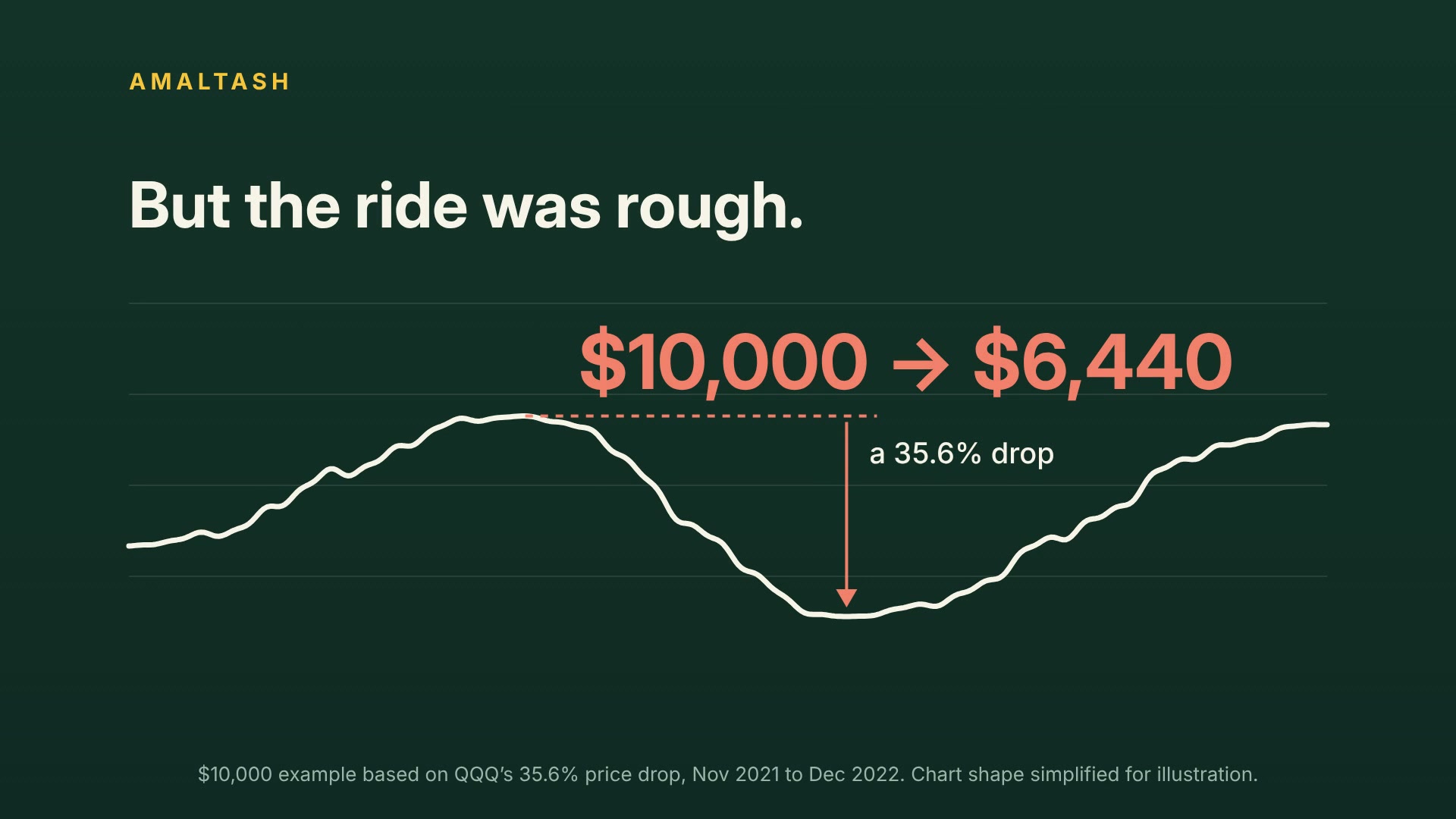
ETFs have long been the industry standard when it comes to diversifying investments to manage risks associated with one stock investments. However with latest market downturns over the past 5 years, ETFs have not escaped the losses as well as seen below.
| ETF | What it holds | Average yearly return | Biggest drop |
|---|---|---|---|
| VOO | Large US companies across every industry | 13.9% | 25.4% |
| IVV | Large US companies across every industry | 13.9% | 25.4% |
| SPY | Large US companies across every industry | 13.9% | 25.4% |
| VTI | US companies of every size, across every industry | 12.8% | 26.2% |
| QQQ | Large Nasdaq companies, mostly tech | 16.9% | 35.6% |
Five years ending Oct 5, 2026. Returns include dividends. These are returns of the ETFs themselves, not of Auto-Managed QQQ, which can earn less than QQQ. The biggest drop is the largest fall in price from a high to a low, which for all five happened in 2022. Sources: ETF Database, Total Real Returns, ChartRow.
Investors often handle such crashes in one of two ways: holding and waiting for prices to recover, or selling during the fall.
Another way to manage risk while owning the ETF
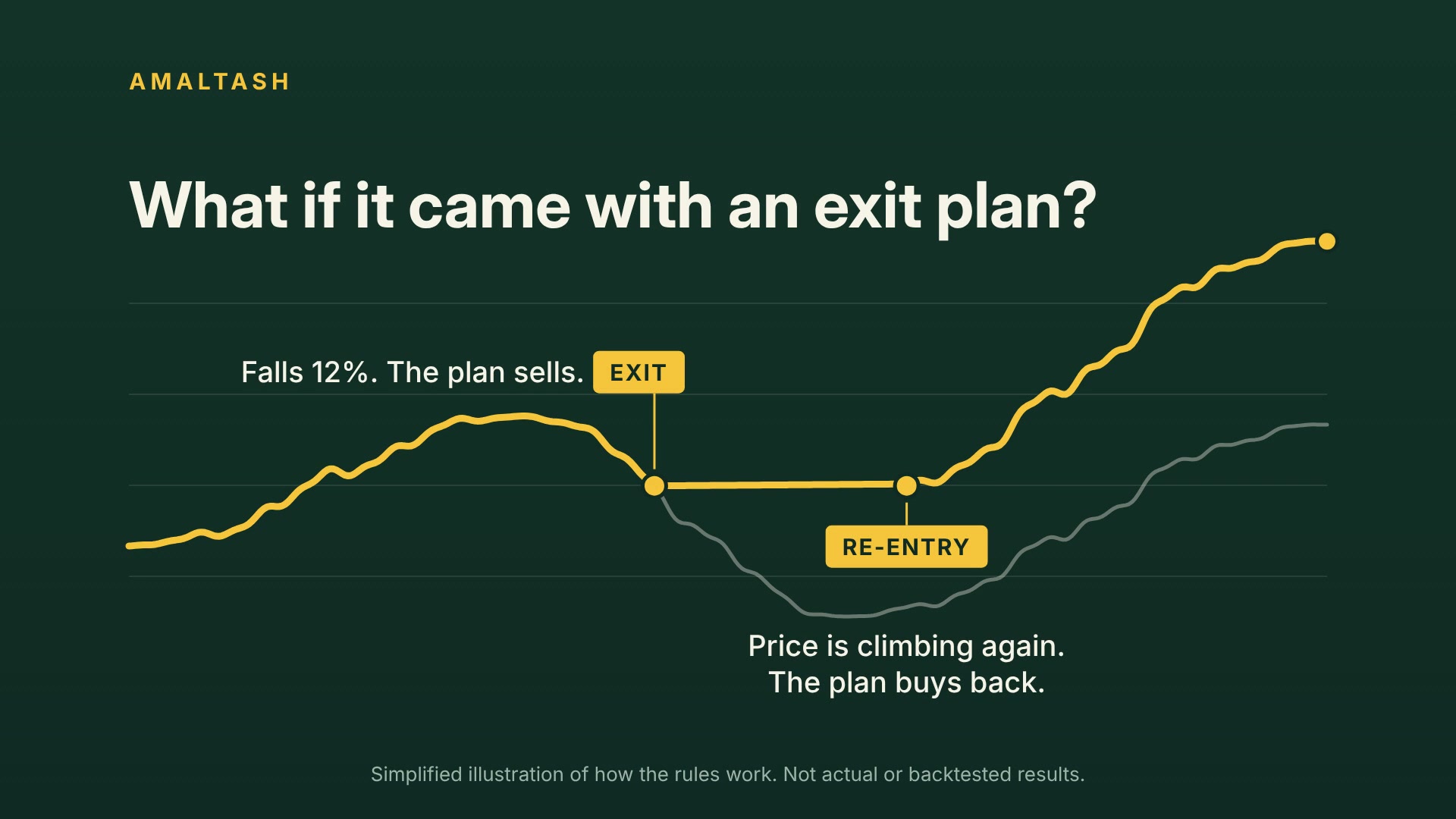
Owning QQQ with a simple rule-based "exit" and "re-entry" criteria.
This could simply read as –
Sell QQQ when it falls 12% below its previous peak price, and buy it again when its price climbs back above its 200-day average.
This is what we created at Amaltash - Auto Managed QQQ. You still own QQQ. The difference is that a clear set of rules decides when to step out and when to step back in, and the system follows them for you.
Let's go through what it does and how you can adapt it to fit your risk profile.
How it works
An entry is when the plan buys. An exit is when the plan sells. A re-entry is when it buys again after an exit.
- Entry. When you start, your money is invested in QQQ. While QQQ is doing well, the plan does nothing. It simply holds.
- Exit. The plan watches the price continuously. If QQQ falls 12% from its recent peak, it sells and moves your money to a safer place.
- Re-entry. The plan keeps watching. When QQQ's price climbs back above its 200-day average, it buys QQQ again.
The 200-day average is the average price of QQQ over the last 200 trading days. When today's price is above that average, QQQ is generally heading up. When it is below, QQQ is generally heading down. It is a simple, rough signal: it reacts late and can mistake a short bounce for a recovery, which can mean selling low and buying back higher.
This keeps happening automatically to keep external news cycle, emotions out of the loop.
What happens to holdings when they exit?
When the plan exits QQQ, your money does not sit idle. It moves into SGOV, a fund that holds short-term US Treasury bills.
SGOV yields about 3.7% a year (as of Oct 2, 2026; this rate changes over time). So even while you are out of QQQ, your money is still earning.
Risk Guardrails
The plan has four guardrails. Each one is a limit that triggers an automatic action.
| Guardrail | Level | What it means |
|---|---|---|
| Stop loss | 12% | If QQQ falls 12% below its recent peak, the plan sells. |
| Drawdown from peak | 12% | If QQQ falls 12% from its recent high, the plan sells. This one moves up as QQQ rises, so the sale point rises with it; a sale still happens only after a 12% fall from the high and can fill lower. |
| Plan-level limit | 20% | Checked every day. If your whole plan is down 20% from its high, it closes the position entirely. |
| Take profit | 50% | If QQQ gains 50%, the plan sells and locks in the gain. |
A "drawdown" is simply how far something has fallen from its highest point. If your balance peaked at $10,000 and is now $9,000, that is a 10% drawdown.
How we tested it
Before we list any plan, we test it in two ways.
A backtest. We run the rules through the five years of real market prices ending Oct 5, 2026. Then we compare the result with simply buying QQQ and holding it the whole time. This shows how the rules would have behaved, and what they would have cost or saved.
Over that period, buying and holding QQQ had a biggest drop of 35.6%. The rules are designed to sell once QQQ falls 12% from its recent peak, but a sale can fill below that level, and selling then buying back higher can leave the plan behind plain QQQ. They are built to limit losses, not fully prevent them.
Stress tests. We also replay the plan through ten difficult periods from the past 15 years. These include the 2020 COVID crash, when the market fell 34% in a few weeks, the long slide of 2022, and the sharp drop in late 2018. We include a slow, sideways year too, because a market that goes nowhere tests a plan in a different way.
You can read the full rules on the Auto-Managed QQQ page.
What you get with Amaltash Investment Plans
The plan sells only after QQQ has already fallen about 12%, so it limits a loss rather than preventing one. If QQQ drops 12% and then bounces back quickly, the plan will have sold near the low and bought back higher. In a strong year with no big drops, it will look a lot like plain QQQ.
What you get in return is a rule based system that helps limit loss.
You decide in advance the point at which the plan steps aside, instead of making that call in the middle of a crash. For many people, that is what makes it possible to stay invested at all.
Index funds are popular because they are simple and open. You always know what you own. Active management has usually meant the opposite: someone else makes decisions you cannot see.
Auto-Managed QQQ sits in between. Your money is actively managed, but by rules you can read, not by someone's opinion.
Backtest and stress-test results are hypothetical. They show how the rules would have performed on past data and are not actual trading results. Past performance does not guarantee future results. All investing involves risk, including the possible loss of the money you invest. SGOV is an exchange-traded fund, not a bank account, and its yield is not guaranteed. Advisory services are provided by Amaltash Advisors LLC, an SEC-registered investment adviser.
How subscribing to a strategy works, what the guardrails do, and what stays under your control.
Educational content published by Amaltash Advisors LLC. Nothing here is investment advice or a recommendation to buy or sell any security. All investing involves risk of loss, including loss of principal, and past performance does not guarantee future results.